

Key Takeaways
- Independent living is housing with services; assisted living adds hands-on personal care; memory care adds a secured setting and dementia-trained staff.
- The deciding question is not age or diagnosis but how much help with daily activities your parent needs today, and how fast that is changing.
- Moving up a level later is normal. Choosing a community that offers the next level on the same campus avoids a second move.
- Expect roughly $3,000–$4,500 a month for independent living, $5,000–$7,000 for assisted living, and $1,000–$2,500 on top of that for memory care.
- A nurse's assessment, which every community does before move-in, is the fastest way to settle a family disagreement about the right level.
Families usually arrive at this question the same way: a fall, a hospital stay, or a visit home where the fridge was empty and the pill organizer was full. Something has to change, and the choices have names that sound alike. This is the plain-English version, level by level, so you can tell which one fits your parent today and which one you may need next year.
The short version
| Independent living | Assisted living | Memory care | |
|---|---|---|---|
| Who it is for | Older adults who manage their own care but want fewer chores and more company | People who need help with some daily activities every day | People with Alzheimer's or another dementia who need supervision to stay safe |
| Personal care | None included; can be added privately | Included and scheduled, with fees by level | Included, with more staff per resident |
| Staff | Concierge, dining, activities; no aides | Aides around the clock, nurse on site or on call | Dementia-trained aides around the clock, nurse on site |
| Setting | Apartments or cottages, come and go freely | Apartments with a call system, open building | Secured wing or building, courtyard, circular layout |
| Typical 2026 cost | $3,000 – $4,500 / month | $5,000 – $7,000 / month | $6,500 – $9,000 / month |
| Licensed? | No (it is housing) | Yes, by the state | Yes, usually with extra requirements |
Independent living: housing with the chores removed
Independent living is an apartment, cottage or villa in a community built for people usually 62 and over. The rent includes things a landlord never gives you: most meals, housekeeping, laundry, transportation, a calendar of activities, and neighbours at the same stage of life. What it does not include is care. Nobody helps your parent bathe, dress, or take medication, because the residents do not need that help.
The right resident for independent living still drives or is happy with a shuttle, manages their own medications, and would rather cook occasionally than daily. What they want is less: less yard, less cooking, less isolation. The typical move is triggered by a spouse dying, a big house becoming a burden, or a winter alone that felt too long.
If care needs arrive later, many independent living residents hire a home care agency to visit, and many communities allow that. But once help is needed most days, assisted living is both safer and, surprisingly often, cheaper than independent living plus private aides.
Browse independent living communities.
Assisted living: help with daily life, built in
Assisted living is for people who need a hand with what the industry calls activities of daily living: bathing, dressing, getting to the toilet, moving from bed to chair, eating, and managing medications. A resident might need help with one of these or all six. The community assesses which, prices it, and builds it into the day.
What a day looks like: an aide checks in and helps with the morning routine, medications come at set times from a med tech or nurse, meals are in a dining room, there is a physical therapist on site a few days a week, and activities fill the afternoon. Residents live in their own apartments, usually with a kitchenette, and come and go as they are able. Family visits whenever they like.
Assisted living is licensed by the state, which sets minimum staffing, training and inspection rules. Those rules vary a great deal between states, which is one reason costs do too.
The classic signs it is time: an unexplained weight loss, missed medications, a fall, unopened mail, the same story told twice in a visit, or a caregiver spouse who is wearing out. We wrote a whole guide to those signs, coming up on the Journal next month.
Browse assisted living communities.
Memory care: assisted living redesigned around dementia
Memory care is not assisted living with a locked door, although the door is part of it. It is a different philosophy. Instead of maximizing independence, it provides structure: a predictable routine, a smaller and calmer building, staff trained in how dementia changes behavior, and activities designed for people who can no longer follow a bingo card but can still enjoy music, movement and touch.
The setting is secured so that a resident who wanders, and roughly six in ten people with dementia will at some point, cannot leave unnoticed. Corridors often loop so there are no dead ends. Staffing is higher than assisted living, typically one aide for every five to seven residents during the day.
A person is ready for memory care when their dementia makes an open building unsafe or when their needs exceed what assisted living aides can manage: wandering, sundowning agitation in the evening, resisting care, or no longer recognizing the apartment as home. A diagnosis alone does not mean memory care; plenty of people with early-stage dementia live well in assisted living for years.
Our guide to what makes memory care different goes deeper on the philosophy and the daily routine.
Browse memory care communities.
How to tell which level your parent needs
Age is not the answer; there are 90-year-olds in independent living and 72-year-olds in memory care. Diagnosis is not the answer either. The answer is function: what your parent can do safely on their own, today.
Work through these questions honestly, ideally with a sibling so nobody is guessing alone.
- Medications. Are they taken correctly every day without prompting? If not, that is the single most common reason independent living stops being enough.
- Bathing and dressing. Can they do both without help and without fear of falling? Skipped showers are an early tell.
- Meals. Are they eating real food, or toast and tea? Check the fridge, not the story.
- Mobility. Any falls in the past year? A fall is the strongest predictor of the next one.
- Judgment and memory. Left the stove on, got lost driving a familiar route, gave money to a caller? Those point toward memory care sooner than families expect.
- Loneliness. How many days a week do they talk to someone in person? Isolation is a health risk on its own and the strongest argument for any community over staying home.
If the honest answers are all fine, independent living is a lifestyle choice. If two or more need help every day, assisted living is the floor. If safety, wandering or judgment are the worry, tour memory care even if it feels early.
The nurse assessment settles it
Every licensed community sends a nurse to assess a prospective resident before move-in. It takes an hour, it is free, and it produces a care plan and a price. If your family cannot agree on the level, let two communities assess and compare their answers. It moves the conversation from opinion to observation.
Plan for the next level, not just this one
Care needs go one direction. The average assisted living resident stays two to three years and a meaningful share move on to memory care or skilled nursing. That is why a community offering more than one level on the same campus, sometimes called a continuum of care, is worth a premium: the next move is down a hallway instead of across town, and the staff already know your parent.
Ask every community what happens when needs increase. The answers range from "we care for residents through end of life" to "we will give you 30 days' notice", and both are said with a smile.
Start with what your parent needs today
The care quiz asks the same questions a placement advisor would, takes two minutes, and points you to the right level and the communities near you that offer it. When you contact a community through Seniors Places it pays nothing, so the answer you get is about your parent, not a referral fee.

Questions to Ask a Memory Care Community: The Printable Checklist
Forty questions for a memory care tour, grouped by what matters most, with the answers to hope for. Print it and take it with you.

12 Signs It May Be Time for Assisted Living (That Families Often Miss)
The quiet signs a parent needs more help than home can give, and what to do once you have seen them.
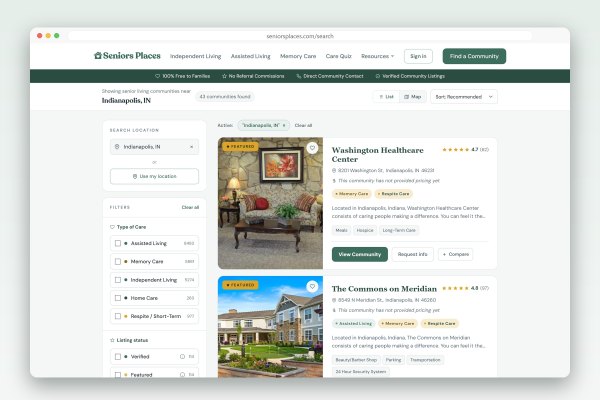
The New Seniors Places: What Changed for Families
Seniors Places has been rebuilt around the family doing the searching: a budget filter, side-by-side comparison, a care quiz with no sales call, community pages that answer the tour questions, and inquiries that go to the community you chose. Free, with no referral fees.

Does Medicaid Pay for Assisted Living? What Each State Waiver Covers
How Medicaid waivers pay for assisted living care, who qualifies, what your state calls it, and how to find a community that takes it.