

Key Takeaways
- Aid and Attendance is a tax-free monthly pension for wartime veterans and their surviving spouses who need help with daily living. It is paid on top of any other income.
- At 2025 rates it is worth up to about $2,358 a month for a single veteran, $2,795 for a veteran with a spouse, and $1,515 for a surviving spouse, adjusted each December.
- Service in a war period is required, but not combat: 90 days of active duty with at least one day during a recognized wartime period, and a discharge other than dishonorable.
- The cost of assisted living counts as a medical expense, which is how most applicants get under the income test.
- Never pay anyone to file the claim. Accredited Veterans Service Officers do it free, and it is a federal offence to charge for preparing a claim.
There is a federal benefit that can pay a large share of an assisted living bill, has existed for decades, and is claimed by only a fraction of the people entitled to it. It is called Aid and Attendance, it is part of the VA pension, and if your parent or their late spouse served during a war period, it is worth an hour of your time this week.
What Aid and Attendance is
The VA pays a needs-based pension to wartime veterans over 65, or permanently disabled, with limited income and assets. Aid and Attendance is an addition to that pension for veterans, or surviving spouses, who need help with daily activities such as bathing, dressing and medication, or who live in a community because of a physical or mental condition. It is paid monthly, it is tax-free, and it does not reduce Social Security or any other benefit.
It is not the same as VA health care, and it is not a disability compensation claim. Your parent does not need a service-connected injury. They need wartime service, a need for help, and a financial picture under the VA's limits.
How much it pays
The VA sets a maximum annual pension rate and pays the difference between that and the applicant's countable income. At the 2025 rates, the maximums with Aid and Attendance are roughly:
| Who | Maximum per month (2025) |
|---|---|
| Single veteran | about $2,358 |
| Veteran with a spouse or dependent | about $2,795 |
| Two married veterans, both eligible | about $3,740 |
| Surviving spouse of a veteran | about $1,515 |
Rates rise each December with the Social Security cost-of-living adjustment, so the 2026 figures are a little higher. Check the VA's current pension rate table before you count on a number.
On a $6,000 assisted living bill, a surviving spouse's benefit covers a quarter of it, and a married veteran's nearly half. Over a three-year stay that is $50,000 to $100,000 the family does not have to find.
Who qualifies
Three tests. All three must be met.
1. Wartime service
The veteran must have served at least 90 days of active duty, with at least one day falling inside a recognized war period, and been discharged under conditions other than dishonorable. Service after September 7, 1980 generally requires 24 months. Combat is not required; a supply clerk stateside during the Korean War qualifies. The periods:
- World War II: December 7, 1941 to December 31, 1946
- Korean War: June 27, 1950 to January 31, 1955
- Vietnam era: November 1, 1955 to May 7, 1975 for service in Vietnam, or August 5, 1964 to May 7, 1975 for service anywhere
- Gulf War: August 2, 1990 to a date not yet set by Congress
A surviving spouse qualifies on the veteran's service, provided they were married at the time of the veteran's death and have not remarried.
2. Medical need
The applicant needs the regular help of another person with daily activities, or is bedridden, or is in a nursing home, or has severely limited eyesight. In practice, a doctor completes VA Form 21-2680 describing the need, and living in assisted living or memory care because of that need is strong evidence.
3. Income and assets
This is where most families wrongly assume they will not qualify. Two things make the test far easier than it looks.
First, unreimbursed medical expenses are deducted from income, and the cost of assisted living counts as a medical expense when the resident needs the care. A widow with $3,000 a month of income and a $5,500 assisted living bill has, for VA purposes, negative income. She qualifies for the full benefit.
Second, the net worth limit is generous, about $159,000 in 2025 and rising each year, and the home, one vehicle and personal belongings do not count. Since 2018 there is a 36-month look-back on gifts and transfers, so do not move money around before applying without advice.
How to apply
- Find the discharge papers. The DD-214 or equivalent. If it is lost, request a copy from the National Archives; it is free and takes a few weeks.
- Get the medical form. Ask the doctor, or the community's nurse, to complete VA Form 21-2680. The community can also provide a statement of the monthly cost and the care provided.
- Gather the finances. Social Security statements, pension statements, bank and investment balances, and receipts for medical expenses including the community's bill.
- File the claim. VA Form 21P-527EZ for a veteran, 21P-534EZ for a surviving spouse, with the medical form attached. File online through VA.gov or through an accredited representative.
- Consider an intent to file. Submitting a notice of intent starts the clock for back pay while you gather documents, up to a year.
Processing takes three to six months in 2026, sometimes longer. The benefit is paid retroactively to the date of the claim, or the intent to file, so delays cost time rather than money.
Get help, but never pay for it
Accredited Veterans Service Officers at the American Legion, VFW, DAV and your county veterans service office prepare and file these claims at no charge, and they do hundreds a year. It is illegal for anyone to charge a fee to prepare a VA pension claim, which has not stopped a small industry of "benefits consultants" from attaching themselves to senior living. If someone offers to help with the claim in exchange for moving assets into an annuity or a trust, walk away.
Mistakes that delay claims
- Filing without the medical form, or with a form that describes the diagnosis but not the need for help.
- Leaving the community's cost off the medical expense list, which is the single biggest reason people appear over the income limit.
- Missing the marriage certificate for a surviving spouse claim.
- Using the wrong form: the basic pension form without the Aid and Attendance evidence pays a much smaller amount.
- Gifting assets to children in the three years before applying.
Communities that understand the benefit
Many communities will complete their part of the paperwork the day you ask, and some hold monthly sessions with a service officer. When you tour, ask whether they have residents receiving Aid and Attendance and who on staff handles the forms. It is a good proxy for how the community treats families generally.
Aid and Attendance stacks with every other way of paying: savings, a home sale, long-term care insurance and, when the money runs low, a Medicaid waiver. Our cost guide covers all of them, and our earlier piece on veterans benefits covers the other programs that can help. When you are ready to look, search communities near you; every inquiry goes to the community directly, at no cost to them or to you.

12 Signs It May Be Time for Assisted Living (That Families Often Miss)
The quiet signs a parent needs more help than home can give, and what to do once you have seen them.
The New Seniors Places: What Changed for Families
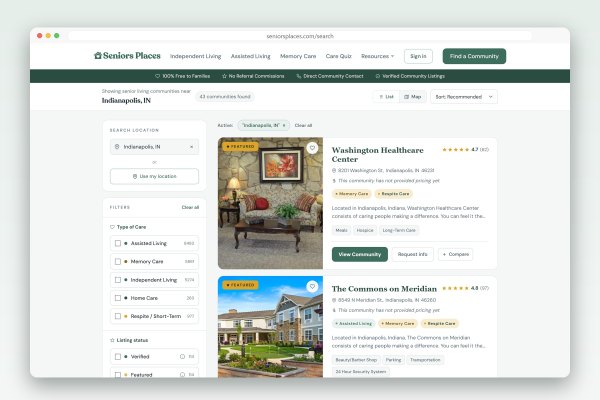
Seniors Places has been rebuilt around the family doing the searching: a budget filter, side-by-side comparison, a care quiz with no sales call, community pages that answer the tour questions, and inquiries that go to the community you chose. Free, with no referral fees.

Does Medicaid Pay for Assisted Living? What Each State Waiver Covers
How Medicaid waivers pay for assisted living care, who qualifies, what your state calls it, and how to find a community that takes it.

The 48 Questions to Ask on a Senior Living Tour
Most first tours end with a folder and a warm feeling. Here are the questions families most wish they had asked, in eight sections, with the free printable checklist to take on every tour.