

Key Takeaways
- Read four sections before anything else: the fee schedule, the rate increase clause, the care assessment and levels language, and involuntary discharge.
- Rate increases are usually uncapped and annual. Ask for the last three years of increases in writing; the answer tells you what the clause will cost.
- Involuntary discharge with 30 days' notice is standard. Ask what conditions trigger it, and whether hospice and two-person transfers are allowed.
- The community fee is rarely refundable. Everything else, from the deposit to the last month's rent, should be spelled out with dates.
- Signing as a responsible party is not the same as guaranteeing payment. Read that signature line, and cross out anything that makes you a guarantor.
The residency agreement arrives after the tour, after the assessment, usually after you have already fallen for the place. It is 25 to 40 pages, and someone will offer to walk you through it in twenty minutes. Take it home instead. This guide shows you which pages carry the money and the risk, what they typically say, and what to ask to change. Nothing here replaces an elder law attorney; for a document this size, an hour of one's time is cheap.
Start with the fee schedule, not page one
Somewhere near the back is a schedule or addendum listing every charge. Read it before the narrative, because the narrative refers to it constantly. You are looking for:
- Base monthly rent for the specific apartment, with the apartment number.
- Care fee at the level your parent was assessed, and the amounts for every other level.
- Medication management, often a separate line, sometimes tiered by number of medications.
- Second-person fee if a couple is moving in together.
- Community fee or move-in fee, and whether any part is refundable.
- Ancillary charges: incontinence supplies, escorts to appointments, extra housekeeping, guest meals, cable, phone, pet fees, a fee for a private-duty aide to enter the building.
Add it up at today's care level and again at the next level up. That second number is your budget, because needs only go one way.
The rate increase clause
Almost every agreement allows the community to raise rent and care fees, usually once a year with 30 to 60 days' notice, and almost none of them cap the increase. Some tie increases to a cost-of-living index; most simply say the community may adjust rates.
You will not get a cap. What you can get, in writing, is the history: the percentage increase in each of the past three years for existing residents. Four to eight percent a year is typical in 2026. A community that will not tell you is telling you something. Ask also whether care fees rise on the same schedule as rent or separately, and whether a change in care level mid-year resets anything.
Care levels and reassessment
This section explains how the community decides how much care your parent needs and therefore what they pay. Look for:
- Who assesses: usually the community's nurse, sometimes with your parent's doctor.
- How often: on move-in, then every 90 days to a year, and after any change in condition or hospital stay.
- Whether you are told before the fee changes, and whether you can dispute an assessment. You want notice in writing and a right to a second assessment.
- What the levels mean. A level defined by minutes of care per day is more transparent than one defined by a point score you cannot see.
A community that raises the care level after a hospital stay without telling the family is the most common billing complaint we hear. The contract should require notice. If it does not, ask for a rider that does.
Involuntary discharge: the clause nobody reads
Every agreement gives the community the right to end the residency. The standard reasons are non-payment, a need for care the community cannot provide, and behaviour that endangers others. Thirty days' notice is typical; some states require more, and most allow immediate transfer in an emergency.
The words to look for are "the community determines" or "in the community's sole judgment". They mean the decision is theirs. So the questions to ask are concrete:
- Can a resident stay if they become a two-person transfer, meaning two aides are needed to move them?
- Can a resident stay on hospice, through end of life?
- What happens if dementia advances: is there a memory care unit on site, and is priority access to it in writing?
- If discharge is required, does the community help find placement, and is rent prorated to the move-out date?
Communities with "aging in place" in the brochure sometimes have a discharge clause that contradicts it. The contract wins.
The money that goes in before day one
Three separate things get confused:
- Community fee. A one-time charge, typically one to two months' rent, for "onboarding". Usually non-refundable after a short window. It is also the fee most often waived toward the end of a quarter, so ask.
- Security deposit. Refundable, less damage, within a set number of days after move-out. Look for the number of days and what counts as damage.
- First month's rent. Sometimes prorated, sometimes not. Moving in on the 25th and paying for the whole month is a $4,000 mistake that a sentence in the contract can prevent.
Notice periods and what happens at the end
Find the resident's own notice period to leave, usually 30 days. Then find what happens on a death: many agreements charge rent until the apartment is cleared, and some charge for a full 30 days regardless. Ask for the death clause to end rent on the date the apartment is emptied, with a short grace period. Most communities will agree; few offer it unprompted.
Also check whether a hospital stay of more than a few weeks pauses the care fee. Rent will continue, which is fair; care fees for care not delivered should not.
The responsible party signature
Adult children are asked to sign as the "responsible party". That should mean the person who handles paperwork and is contacted in an emergency. In some agreements it quietly also means the person who guarantees payment from their own money. Read the definition. If it includes words like "personally liable" or "guarantor", cross them out, initial the change, and ask the community to initial it too. Federal rules already bar nursing homes from requiring a third-party guarantee; assisted living is regulated by states and the rule varies, so the contract is what protects you.
Arbitration and liability
Many agreements include a clause requiring disputes to go to arbitration rather than court, and some limit the community's liability. You can usually strike an arbitration clause and still move in; communities rarely refuse a resident over it. At minimum, make sure signing it is optional and not buried in the main agreement.
What to ask for in writing
Communities negotiate more than they admit. These are reasonable requests that get a yes more often than not:
- The past three years of rate increases, on letterhead.
- Written notice before any care level change, with a right to a second assessment.
- Rent prorated on move-in and ending on the date the apartment is cleared after a death.
- A waived or reduced community fee.
- Priority transfer to the community's own memory care, if it has one.
- The discharge policy for hospice and two-person transfers, in writing.
Before you sign
Have someone else read it who is not in love with the courtyard. If there is a house sale, a spouse still at home, or any hope of a Medicaid waiver later, that someone should be an elder law attorney; a review takes an hour and costs a fraction of one month's rent. And put the four sections above in a folder you can find in two years, because that is when you will need them.
If you are still comparing communities, our cost guide covers what sits behind the numbers, and the community search shows starting prices before you ever pick up the phone.

Veterans Benefits for Senior Living: Aid & Attendance Explained
How the VA's Aid and Attendance pension can pay a large share of assisted living, who qualifies, and how to apply without the usual delays.

Questions to Ask a Memory Care Community: The Printable Checklist
Forty questions for a memory care tour, grouped by what matters most, with the answers to hope for. Print it and take it with you.

12 Signs It May Be Time for Assisted Living (That Families Often Miss)
The quiet signs a parent needs more help than home can give, and what to do once you have seen them.
The New Seniors Places: What Changed for Families
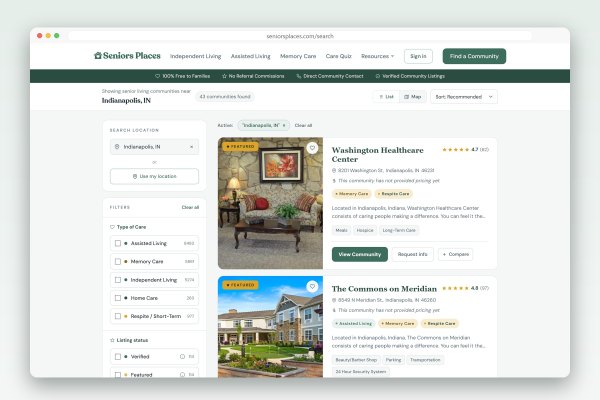
Seniors Places has been rebuilt around the family doing the searching: a budget filter, side-by-side comparison, a care quiz with no sales call, community pages that answer the tour questions, and inquiries that go to the community you chose. Free, with no referral fees.