

Key Takeaways
- In 2026 a private assisted living apartment runs about $5,500 to $7,000 a month in most of the country, with care fees on top of the base rent.
- The gap between states is enormous: the Deep South and Midwest often sit under $5,000 while the Northeast, Pacific Northwest and Alaska pass $8,000.
- The advertised rate is rarely the bill. Ask for the all-in monthly figure at the care level your parent needs today, and the rate at the next level up.
- Medicare does not pay for assisted living. Most families pay from savings, a home sale, long-term care insurance, VA Aid & Attendance or a state Medicaid waiver.
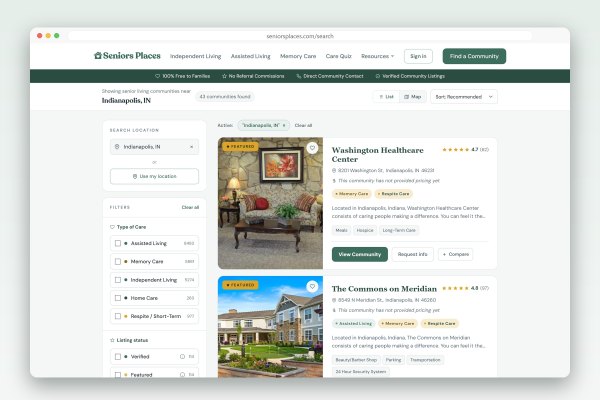
- Communities on Seniors Places list a starting price on their card, so you can filter by budget before you ever pick up the phone.
The first question every family asks is the one communities are slowest to answer: what is this going to cost? This guide gives you the real numbers for 2026, shows how much they move from state to state, and explains what sits behind the figure on the brochure. Use it to set a budget before you tour, not after.
The national picture in 2026
Across the United States, the median price of a private assisted living apartment in 2026 is roughly $5,900 a month, or about $71,000 a year. That figure has been climbing four to six percent a year since 2021, faster than general inflation, because the two biggest costs in a community are staff wages and building costs, and both rose sharply.
That median hides a wide spread. A quarter of communities charge under $4,500. A quarter charge over $7,500. Where a community sits in that range depends far more on its location and its care model than on how nice the lobby looks.
For comparison, in 2026 you can expect:
- Independent living: $3,000 to $4,500 a month for an apartment with meals and activities, no personal care.
- Assisted living: $5,000 to $7,000 a month including a base level of help with daily tasks.
- Memory care: $1,000 to $2,500 a month more than assisted living in the same community, for secured settings and higher staffing.
- A nursing home: $9,500 or more a month for a private room, because it provides licensed nursing around the clock.
Assisted living cost by state
The table shows the typical monthly range for a private assisted living apartment at a base care level in 2026. The ranges are drawn from published cost-of-care surveys and from the starting prices communities list on Seniors Places, rounded to the nearest hundred. Individual communities, and especially large cities, will fall outside them.
| State | Typical monthly range | Notes |
|---|---|---|
| Alabama | $3,800 – $5,200 | Among the lowest in the country |
| Arizona | $4,500 – $6,200 | Phoenix and Scottsdale at the top of the range |
| California | $5,500 – $8,500 | Bay Area and coastal Southern California highest |
| Colorado | $5,200 – $7,000 | Denver metro well above the rest of the state |
| Florida | $4,300 – $6,500 | Wide spread; Naples and Palm Beach far higher than inland |
| Georgia | $4,000 – $5,800 | Atlanta suburbs at the top |
| Illinois | $5,000 – $7,000 | Chicago collar counties highest |
| Indiana | $4,500 – $6,200 | Indianapolis suburbs mid-range; rural counties lower |
| Massachusetts | $6,800 – $9,000 | Consistently among the most expensive states |
| Michigan | $4,500 – $6,300 | Detroit and Grand Rapids metros highest |
| Minnesota | $5,000 – $7,200 | Twin Cities well above outstate |
| Missouri | $3,600 – $5,000 | One of the least expensive states |
| New Jersey | $6,500 – $8,800 | Northern counties near New York highest |
| New York | $5,000 – $8,000 | Huge gap between upstate and the city |
| North Carolina | $4,500 – $6,300 | Charlotte and the Triangle at the top |
| Ohio | $4,800 – $6,500 | Columbus and Cincinnati suburbs highest |
| Pennsylvania | $4,800 – $7,000 | Philadelphia suburbs well above Pittsburgh |
| Texas | $4,300 – $6,200 | Austin and Dallas suburbs at the top |
| Virginia | $5,000 – $7,200 | Northern Virginia far above the rest of the state |
| Washington | $6,000 – $8,200 | Seattle metro among the priciest in the country |
Two patterns show up everywhere. Big metros cost 20 to 40 percent more than the rest of their state. And states with more communities competing for residents tend to have wider ranges, which means more choice at the lower end if you are willing to look a little further out.
Our cost of senior living page is updated from the prices communities publish on their listings, so it is worth checking for your city before you set a number.
What is actually in the price
Most communities price in two parts, and the difference matters when you compare them.
Base rent
The base rate covers the apartment, three meals a day, housekeeping, laundry, utilities, activities, transportation on a schedule, and a call system. A studio is cheapest. A one-bedroom typically adds $500 to $1,200. A companion suite, shared with another resident, can cut the rent by a third.
Care fees
On top of rent, communities charge for personal care: help with bathing, dressing, medication, mobility and toileting. They do this one of three ways.
- Levels of care. A nurse assesses your parent and places them in a tier, often four or five of them, each with a set monthly fee. Level one might add $600. Level four might add $2,500.
- Points or à la carte. Each task carries a price, and the monthly fee is the sum. Transparent, but it climbs quickly as needs grow.
- All-inclusive. One rate covers any care level. It looks expensive on day one and becomes a bargain when needs increase.
Medication management is the fee families most often miss. Expect $300 to $700 a month if staff hand out medications, and more if there are injections.
One-time charges
Most communities charge a community fee or move-in fee, usually one to two months' rent, and it is rarely refundable. Some also charge an assessment fee before move-in. Ask whether either is negotiable. Toward the end of a quarter, when a community has empty apartments, it often is.
Why one community costs $4,800 and the one next door costs $7,200
When two communities a mile apart are $2,400 a month apart, it usually comes down to a few things:
- Staffing ratio. More caregivers per resident is the single biggest driver, and the one that matters most to daily life. Ask how many residents each aide supports on the overnight shift, not just during the day.
- Nurse coverage. A licensed nurse on site around the clock costs far more than one on call.
- Building age. A community built in the last five years carries higher debt and higher rents.
- Apartment size and private bathrooms. Older buildings with shared bathrooms are cheaper for a reason.
- Dining. Restaurant-style dining with a chef and menu choice costs more than set meals at set times.
- Ownership. Large national operators, nonprofits, and local family-owned communities price differently, and none of the three is reliably cheapest.
How families actually pay for it
The question behind the question is usually how anyone affords this. Here is how most families do it, often in combination.
Private savings and income
Social Security, a pension, and retirement savings cover the bulk of assisted living for most residents. A realistic budget adds up monthly income, then decides how many years of savings you are willing to draw down. Five years is a common planning horizon; the average stay in assisted living is around two to three years.
Selling the house
For many families the home is the plan. A sale can fund several years of care outright. A bridge loan or a reverse mortgage can cover the months between move-in and closing.
Long-term care insurance
If your parent bought a policy years ago, read it now. Most pay a daily benefit for assisted living once your parent needs help with two or more daily activities, after a waiting period of 30 to 90 days. Communities are used to the paperwork and will help.
Veterans benefits
A wartime veteran or a surviving spouse who needs help with daily activities may qualify for the VA's Aid and Attendance benefit, worth over $2,300 a month for a single veteran in 2025 rates. It is one of the most under-claimed benefits in the country.
Medicaid waivers
Medicare does not pay for assisted living, full stop. Medicaid can, in most states, through a home and community based services waiver, but only at communities that accept it and usually with a waiting list. If your parent's savings are limited, ask every community you tour whether they take the state waiver and whether they let residents convert to it later.
Life insurance and annuities
Some policies can be sold or converted into a long-term care benefit. It is worth a conversation with a fee-only financial planner before you cash anything in.
Six questions that get you the real number
- What is the all-in monthly cost for my parent at the care level your nurse assessed today?
- What would it be at the next care level up?
- How much did rates rise in each of the last three years?
- Is the community fee refundable, and is it negotiable?
- What happens financially if my parent's savings run out?
- Is there anything on your fee schedule that is not on this quote?
Write the answers down for every community you visit. Two quotes that look $800 apart on paper are often $200 apart once the care fees are included.
Where to start
Every community listed on Seniors Places shows its starting price on its card, or says plainly that it has not provided one yet. Search your city, filter by monthly budget, and read the full listing before you call. Communities pay nothing when you contact them through us, so the inquiry goes straight to the person who can answer these questions, and you will never be steered toward the community that pays the biggest referral fee.
Find assisted living near you, or take the two-minute care quiz if you are not yet sure assisted living is the right level.

Questions to Ask a Memory Care Community: The Printable Checklist
Forty questions for a memory care tour, grouped by what matters most, with the answers to hope for. Print it and take it with you.

12 Signs It May Be Time for Assisted Living (That Families Often Miss)
The quiet signs a parent needs more help than home can give, and what to do once you have seen them.
The New Seniors Places: What Changed for Families
Seniors Places has been rebuilt around the family doing the searching: a budget filter, side-by-side comparison, a care quiz with no sales call, community pages that answer the tour questions, and inquiries that go to the community you chose. Free, with no referral fees.

Does Medicaid Pay for Assisted Living? What Each State Waiver Covers
How Medicaid waivers pay for assisted living care, who qualifies, what your state calls it, and how to find a community that takes it.