

Key Takeaways
- Staffing is the whole ballgame. Ask for the resident-to-aide ratio on days, evenings and overnight separately, and how long the current aides have worked there.
- Ask what dementia training staff get, how many hours, and whether it is repeated. A certificate on the wall is not the same as a trained shift.
- Watch the residents, not the lobby. Are they engaged, groomed and calm at 11 a.m. and again at 4 p.m.? Sundowning shows the truth of a community.
- Get the discharge policy in writing. Every community says it cares for residents through end of life until it is asked to put that in the contract.
- The all-in monthly price at the assessed care level, and the rate for the next level up, is the only number that matters.
A memory care tour lasts about an hour, and most of it is spent looking at a bistro, a courtyard and a model apartment. None of those will matter at 3 a.m. when your mother is frightened and someone has to know how to reach her. These are the questions that get past the tour script. Print them, take them in, and write the answers down while they are fresh. Two communities with identical brochures can be very different places once you have their answers side by side.
Before you go
Book the tour at a meal time so you see the dining room in use, and ask to come back unannounced once, late afternoon, before you sign anything. A community confident in its care will say yes. Bring your parent if they can manage it; their reaction to the space tells you things no question can.
Staffing
Everything downstream of this section depends on it.
- How many residents does each care aide support during the day? In the evening? Overnight? (Hope for: around 1 to 6 by day, no worse than 1 to 10 overnight.)
- Is there a licensed nurse in the building around the clock, or on call? What is the response time if on call?
- How long have your current aides worked here, on average? How many left in the past year?
- Do you use agency or temporary staff? How often?
- Who is the memory care director, and how long have they been in the role?
- May I speak with an aide, not a manager, for five minutes?
Training
- What dementia-specific training does every staff member complete before working alone with residents? How many hours?
- Is that training repeated each year? By whom?
- Are dining, housekeeping and activities staff trained too, or only aides?
- How are staff taught to respond when a resident refuses care, becomes agitated, or tries to leave?
- Do you use any restraints, physical or chemical? (The right answer is no, with an explanation of what they do instead.)
Safety and the building
- How is the unit secured, and how do families come and go?
- What happens if a resident tries the door repeatedly? Walk me through the last time.
- Is there a secure outdoor space residents can use on their own, and is it open every day?
- How do you monitor residents overnight? Room checks how often?
- How do you prevent and respond to falls? What is your fall rate?
- Are bathrooms private, and are showers walk-in?
- What is the emergency plan for a fire or a power outage, and when was it last practised?
Daily life
Ask, then watch. The answers should match what you see.
- What does a typical day look like from waking to bedtime?
- What activities are offered, how many residents join them, and what happens for those who cannot?
- How do you learn each resident's life story, and how is it used day to day?
- How do you handle a resident who does not want to get up, eat, or bathe?
- Can residents keep a familiar routine, such as a late breakfast or a nightly bath?
- How is dining adapted for people who struggle with cutlery, or who forget to eat?
- Are there outings? How often, and with what supervision?
- What happens at 4 p.m.? (Late afternoon is when agitation peaks. A good community has a plan for it.)
Medical care
- Who manages medications, and how are changes communicated to families?
- Does a physician or nurse practitioner visit on site? How often?
- How do you handle a change in condition: who calls the doctor, who calls me, and how quickly?
- How do you approach behavioural symptoms before considering medication?
- Can you support hospice in place? Have you done so recently?
- What conditions can you not manage, and what happens then?
Family
- How and how often will I hear from you when nothing is wrong?
- Is there a family council or support group?
- Can I visit at any hour, including nights?
- Who is my single point of contact when I have a concern, and what is their phone number?
Cost and contract
- What is the all-in monthly cost for my parent at the care level you assessed, and what would it be at the next level?
- How much did rates increase in each of the past three years?
- What is the community fee, and is any of it refundable?
- Under what circumstances would you ask a resident to leave, and with how much notice? May I see that section of the contract now?
- Do you accept the state Medicaid waiver, and can a private-pay resident convert to it later?
What to look for while they answer
- Residents' faces. Groomed, dressed, calm, engaged with someone. Rows of people asleep in chairs at 11 a.m. is the wrong answer.
- Staff faces. Do they know residents by name? Do they crouch to eye level? Do they look at you when you walk past, or at the floor?
- Smell. A well-run unit smells of lunch, not of urine and not of air freshener.
- Noise. A television blaring to an empty room is a sign that activities are on paper only.
- Your parent. Did they relax, or tighten? They cannot always tell you, but their shoulders can.
After the tour
Rank the communities on staffing, training and the 4 p.m. answer before you think about the décor. Then call your top choice and ask to visit unannounced. Read our guide to what makes memory care different if you are still deciding whether it is the right level, and use the memory care search to find communities near you. Every inquiry through Seniors Places goes straight to the community, which pays nothing for it, so there is no one between you and a straight answer.

12 Signs It May Be Time for Assisted Living (That Families Often Miss)
The quiet signs a parent needs more help than home can give, and what to do once you have seen them.
The New Seniors Places: What Changed for Families
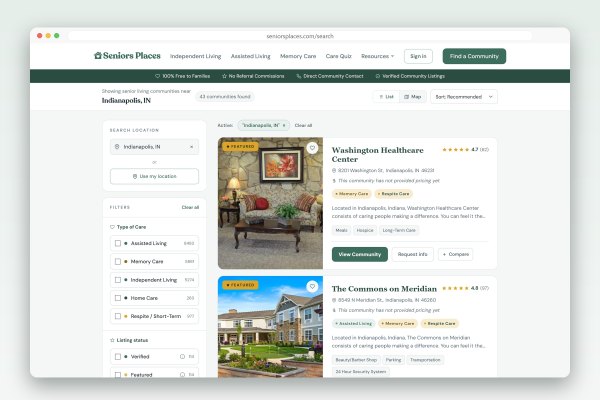
Seniors Places has been rebuilt around the family doing the searching: a budget filter, side-by-side comparison, a care quiz with no sales call, community pages that answer the tour questions, and inquiries that go to the community you chose. Free, with no referral fees.

Does Medicaid Pay for Assisted Living? What Each State Waiver Covers
How Medicaid waivers pay for assisted living care, who qualifies, what your state calls it, and how to find a community that takes it.
The 48 Questions to Ask on a Senior Living Tour
Most first tours end with a folder and a warm feeling. Here are the questions families most wish they had asked, in eight sections, with the free printable checklist to take on every tour.