

Key Takeaways
- Ask who covers nights and weekends, and the caregiver-to-resident ratio at 2 AM, not 2 PM.
- Get the level-of-care fee schedule and last year's rate increase in writing before the tour.
- Eat the regular lunch in the dining room; it tells you more than the model apartment.
- Take the same checklist to every community so the comparison is fair.
Most first tours go the same way. A friendly director walks you through the lobby, the dining room and a model apartment, you nod at the activity calendar, and you leave with a folder and a warm feeling. Then, in the car, the questions arrive: who is on the floor at 2 AM, what happens to the rate next year, what does "level of care" actually cost. The folder rarely answers them.
That is why we built the Community Tour Checklist: 48 questions in eight sections, one copy per community, so the second and third tours are as sharp as the first. Below are the questions families tell us they most wish they had asked, section by section. The full list is on the checklist page. No account is needed to use it on your phone or tablet during a tour. A free Seniors Places account adds two things: your completed checklist is saved so you can come back to it on any device, and you get the printable PDF.
First impressions, and what they hide
Trust the smell test and the sound test. A building that smells clean without smelling of bleach, where staff greet residents by name as you pass, tells you more than a renovated lobby. Two questions to add:
- How long has the executive director been here? Turnover at the top usually shows up on the floor within a year.
- Can we come back unannounced? A confident community says yes.
Staff and care quality
This is the section that decides whether a community is right, and it is the one families skip because it feels awkward to ask. Ask anyway.
- Who covers nights and weekends, and how many residents to each caregiver? Daytime ratios are what you are shown. Night ratios are what your parent will live with.
- How is a change in care needs handled? Who assesses it, how quickly, and what it costs. Get the level-of-care fee schedule in writing.
- What is the staff turnover rate? Under 40 percent a year is good for the industry. Anyone who cannot answer has not looked.
Resident life and activities
The calendar on the wall is a plan, not a record. Ask to see last month's, then ask how many residents actually turned up to the Tuesday outing. Watch a common area for ten minutes: are residents talking to each other, or sitting alone facing a television?
Dining and nutrition
Ask to have lunch in the dining room during the tour. Not a private tasting, the regular meal at the regular time. You will learn the food quality, how staff treat slower eaters, and whether the room is a social place or a cafeteria. Then ask about the things the menu does not show: therapeutic diets, snacks between meals, and what happens when someone misses dinner.
Safety and security
Every community has an emergency plan. Ask when it was last practised and whether residents took part. Ask how a fall at night is detected, how long a response takes, and how the family hears about it. If memory care is in the picture, ask how the doors work and who decides when a resident is no longer safe on an open floor.
The apartment
Model apartments are furnished to sell. Ask to see an available unit as it stands, then check the details that make daily life easier: a walk-in shower with grab bars, wide doorways, an emergency pull cord that reaches the floor, natural light, and a thermostat the resident controls. Ask which utilities and services are included in the rent for that specific unit.
The contract and the money
This section is where surprises live, and it is the one to read before the tour rather than after.
- What does the monthly rate not include? Medication management, incontinence care, escorts to appointments and second-person assists are common add-ons.
- How much notice do you give before a rate increase, and what was last year's? Three to eight percent a year is typical. A community that cannot tell you last year's figure is telling you something.
- What is the move-in or community fee, and is any of it refundable?
- What happens if my parent outlives the money? Some communities accept Medicaid after a private-pay period. Many do not. Ask now, not in year three.
If you want to know what the numbers should look like before you walk in, our senior living cost guide covers what a monthly rate usually includes, state by state.
Trust your gut
After the tour, sit in the parking lot for five minutes before driving away and answer six questions honestly. Could I see my parent thriving here, not just being cared for? Did the staff feel genuinely warm, or rehearsed? Were my questions answered, or redirected? Would I be comfortable here myself one day? Do I want to come back for a second visit? And the one that settles most decisions: what is the one thing that would make me say no, and did I check it?
Take the same list to every tour
The checklist only works if you use the same one at every community. That is what makes the comparison fair. Open the Community Tour Checklist to work through it on your phone during the tour, or create a free account and we will email you the printable PDF, one copy per community, with room for notes and a rating for each section.
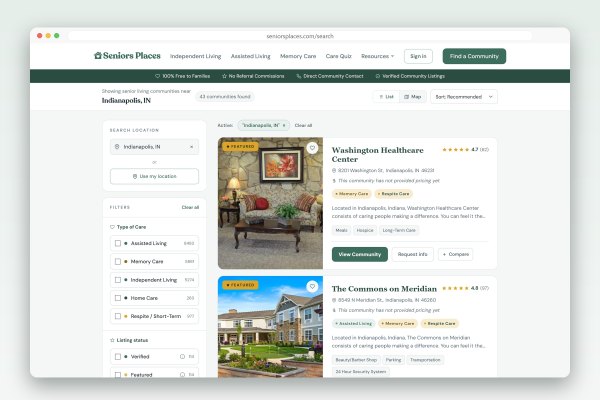
Not sure which communities to tour yet? Search by city and type of care, save the ones that fit, and compare up to three side by side. If the type of care itself is the open question, the two-minute care quiz is the place to start.
Seniors Places is commission-free. We never take a referral fee, so nothing on the site is ranked by what a community pays, and every inquiry goes to the community itself.

Questions to Ask a Memory Care Community: The Printable Checklist
Forty questions for a memory care tour, grouped by what matters most, with the answers to hope for. Print it and take it with you.

12 Signs It May Be Time for Assisted Living (That Families Often Miss)
The quiet signs a parent needs more help than home can give, and what to do once you have seen them.
The New Seniors Places: What Changed for Families
Seniors Places has been rebuilt around the family doing the searching: a budget filter, side-by-side comparison, a care quiz with no sales call, community pages that answer the tour questions, and inquiries that go to the community you chose. Free, with no referral fees.

Does Medicaid Pay for Assisted Living? What Each State Waiver Covers
How Medicaid waivers pay for assisted living care, who qualifies, what your state calls it, and how to find a community that takes it.